Unbox, Pour, Taste: How to Turn a Cheese Delivery Into the Best Party You've Thrown All Year

Unbox, Pour, Taste: How to Turn a Cheese Delivery Into the Best Party You've Thrown All Year
Let's be honest. You've hosted enough dinner parties to know the math doesn't always work out. Hours of cooking, a kitchen that looks like a crime scene, and at least one guest who claims they "don't do gluten" approximately thirty seconds before you serve the pasta. It's exhausting.
Here's a better idea: a guided cheese tasting night. Same social energy, fraction of the effort, and the only thing you need to prep is your couch cushions and a cheese knife. When your CheddrBox delivery arrives, you're not just getting cheese — you're getting the raw material for a genuinely impressive evening that your friends will talk about long after the last crumb disappears.
This is how you run it.
Set the Scene Before Anyone Walks Through the Door
Atmosphere does a lot of the heavy lifting at a tasting. You don't need a sommelier or a marble countertop. You need two things: low, warm lighting and something playing softly in the background. A jazz playlist on Spotify, a few candles, maybe a linen napkin or two. The goal is "charming cheese shop in the West Village," not "fluorescent-lit kitchen at 7 PM on a Tuesday."
Pull your cheeses out of the fridge about 45 minutes before guests arrive. This is non-negotiable. Cold cheese is closed-off cheese — the fat hasn't loosened, the aromas are muted, and you're basically tasting a shadow of what it could be. Room temperature is where the magic lives. Set each wedge on a board with a little label (a torn piece of masking tape and a Sharpie works perfectly), and resist the urge to slice everything in advance. Half the fun is watching people hack into a wheel themselves.
Build Your Lineup Like a Playlist
Order matters. Tasting cheese is a lot like listening to music — you want to build from delicate to bold, not the other way around. Starting with a funky washed-rind after a mild fresh chèvre is like opening a concert with the loudest song. Nobody recovers from that.
A solid tasting arc for four to six people looks something like this:
Start fresh. Kick things off with something bright and young — a fresh chèvre, a mild ricotta-style, or a young mozzarella. These are easy entry points, and they let your palate wake up without getting overwhelmed.
Move to semi-soft. A buttery Havarti, a young Gouda, or a mild Fontina. This is the "getting comfortable" phase of the evening. Conversation picks up here.
Go firm and aged. Aged cheddar, Manchego, Gruyère, Comté — this is where things get interesting. Crystals start showing up, flavors get nuttier and more complex, and someone at the table will inevitably say "wait, what IS that?" in a genuinely delighted way.
Finish bold. A blue, a washed-rind, or something with real funk. This is the closer, the encore, the thing people either love immediately or need three bites to appreciate. Both reactions are correct.
If your CheddrBox comes with tasting notes — and it should — read them out loud as you introduce each cheese. You'll sound like you know exactly what you're doing, because you will.
The Pairing Game: Make It Interactive
Here's where a tasting night separates itself from just "eating cheese on the couch." Give everyone something to pair with, and let them figure out what works.
Set out a few simple options: a dry sparkling wine or Champagne for the fresh cheeses, a crisp white like Sauvignon Blanc or an unoaked Chardonnay for the semi-softs, and a medium-bodied red — a Pinot Noir or a Côtes du Rhône — for the aged varieties. For the bold finisher, a small pour of something sweet (a Sauternes, a tawny port, or even a local honey drizzled directly on the cheese) is genuinely transformative.
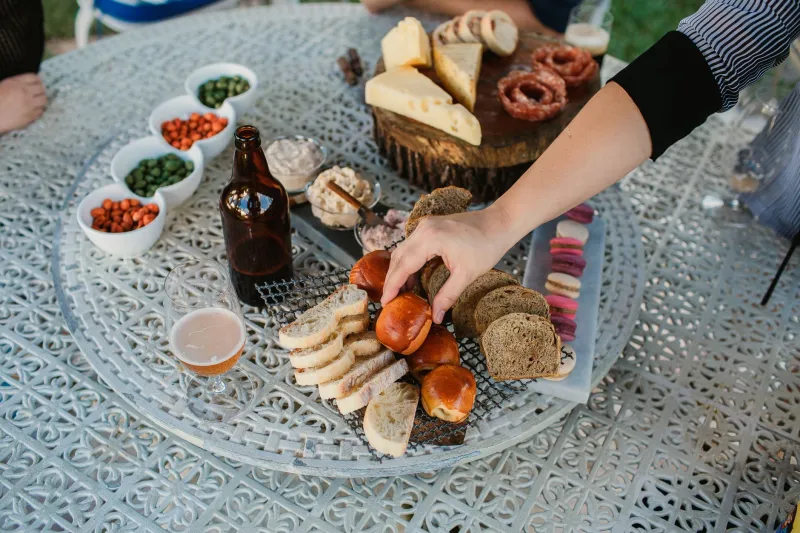
If wine isn't the vibe, don't sweat it. A rotating selection of craft beers works beautifully — a wheat beer with fresh cheese, an IPA with aged cheddar, a stout with blue. Hard ciders are underrated here too, especially with washed-rinds.
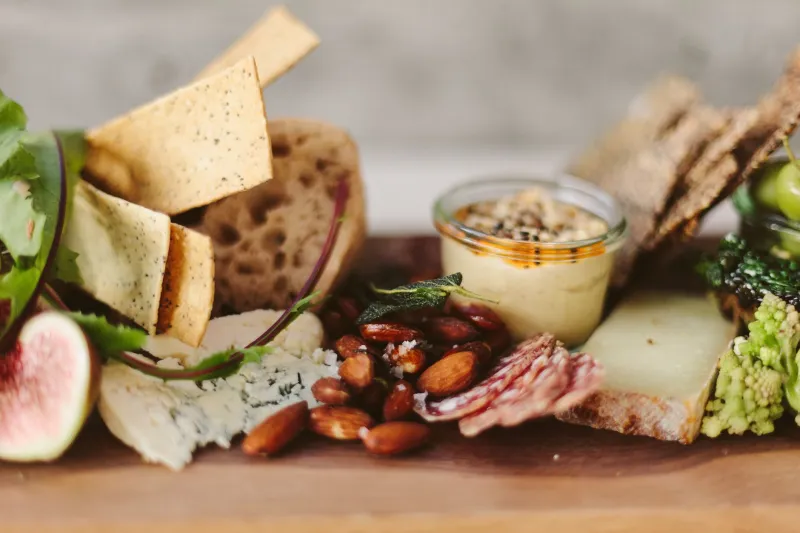
Then add the extras: a small bowl of honeycomb, some Marcona almonds, a few slices of prosciutto, and a handful of different crackers. Tell everyone to experiment. The person who discovers that a smear of blue cheese on a dark chocolate cracker is actually a revelation? That's your guest of honor now.
How to Lead the Tasting Without Feeling Like a Dork
You don't need a certification or a French accent to lead this. You just need a loose structure and the confidence to say "okay, everyone grab a piece of this one."
For each cheese, hit four beats:
- What it is — name, style, where it's from.
- What to look for — texture, rind, any visible crystals or mold.
- What it might taste like — use the tasting notes from your box, but riff freely. "Buttery," "grassy," "sharp," "kind of like a really good Parmesan but wilder" are all valid.
- The question — ask the table what they're getting. This is the part where the evening actually becomes a conversation instead of a lecture.
People are surprisingly opinionated about cheese once they feel like they have permission to be. Someone will taste "barnyard" in a washed-rind and either love it or make a face. Someone else will announce that they've been eating the wrong cheddar their entire life. These are the moments.
The Part Nobody Talks About: The Palate Reset
Between each cheese, have plain water crackers or sliced baguette available, and a glass of water. Encourage people to actually use them. This isn't just etiquette — it genuinely clears the palate so the next cheese gets a fair shot. Skipping this step is why people think they don't like blue cheese when really they just tried it right after a sharp aged cheddar and their taste buds were still in shock.
End on a High Note
After the final cheese, bring out something sweet. A small plate of dark chocolate, a bowl of fresh grapes, or a few fig preserves. Let people go back and revisit their favorites. This is the free-form portion of the evening, and it's usually where the best conversations happen — about what surprised them, what they'd order again, and what they'd never touch with a ten-foot pole.
If you want to send everyone home with something, write down the name of the cheese that got the biggest reaction of the night and tuck it into a text the next morning. "You have to order that Époisses again." They'll thank you.
The beauty of building a tasting night around a curated delivery is that the curation is already done for you. The discovery is built in. All you have to do is show up, open the box, and let the cheese do the talking. Which, as any CheddrBox subscriber will tell you, it absolutely will.