From Lost to Found: The New Cheesemakers Bringing America's Forgotten Dairy Traditions Back to Life
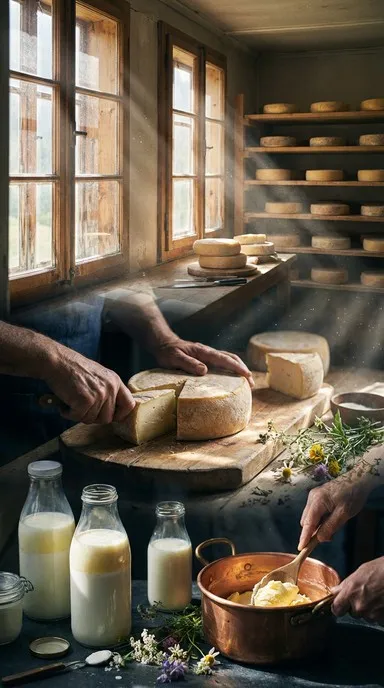
Photo: traditional cheesemaking heritage farmstead artisan creamery hands-on, via images.stockcake.com
There's a version of American cheese history that most people know: Kraft singles, Velveeta, the occasional block of supermarket cheddar. But underneath that very orange surface story lies something far more interesting — a rich, diverse, and largely forgotten patchwork of regional cheesemaking traditions that once stretched from New England saltbox farms to California mission dairies to Indigenous communities across the Great Plains.
Most of those traditions didn't survive the twentieth century. Industrial consolidation, two World Wars, Prohibition (which wiped out the wine and beer cultures that supported artisan cheese), and the rise of refrigeration all conspired to flatten American dairy into something efficient, consistent, and largely flavorless.
But something is happening in creameries, archives, and university agriculture departments across the country. A new generation of cheesemakers — some trained in Europe, some self-taught, some working directly with community elders — is doing the painstaking work of recovery. And the cheeses they're producing aren't museum pieces. They're alive, delicious, and available right now.
The Colonial Pantry, Revisited
Before the American Revolution, New England farmsteads produced cheeses that were practical, long-lasting, and deeply tied to the rhythms of dairy farming. Hard, aged wheels that could survive a winter without refrigeration. Fresh curds eaten the same day they were made. Whey-based drinks that used every drop of milk the cows produced.
Most of those recipes were passed down orally, which means they largely disappeared when the farms that made them were consolidated or abandoned. What remained were scattered references in household account books, agricultural journals, and the occasional handwritten recipe tucked into the back of a Bible.
Cheesemakers in Connecticut, Massachusetts, and New Hampshire have been working with historical societies and food historians to reconstruct some of these recipes. The results are genuinely surprising — colonial-era cheeses weren't the bland, hard blocks you might imagine. Many were herb-infused, some were smoked, and a few used aging techniques that produce flavors we'd now associate with artisan European styles.
The Immigrant Cheese: Styles That Crossed the Ocean and Then Disappeared
America's great waves of immigration brought cheesemaking traditions from every corner of Europe — and many of them briefly flourished before being absorbed or abandoned under economic pressure.
Scandinavian immigrants in Minnesota and Wisconsin brought with them recipes for brown cheese (brunost) and fresh farmer's cheeses that were staples back home. German settlers in Pennsylvania and Texas made styles that reflected their regional origins — soft, spreadable varieties and aged wheels that bore little resemblance to anything produced commercially today. Italian immigrants in New York and California made fresh mozzarella, ricotta, and aged caciocavallo in basement operations that fed their communities for decades.
Most of these traditions faded by the mid-twentieth century as immigrant communities assimilated and the economic incentives for small-batch production disappeared. But the recipes didn't entirely vanish — they survived in family notebooks, community cookbooks, and the memories of people who watched their grandparents make cheese in kitchens that smelled like warm milk and culture.
Today, makers like those at Alemar Cheese Company in Minnesota are drawing explicitly on Scandinavian dairy traditions, producing soft-ripened cheeses that reflect the upper Midwest's heritage rather than defaulting to French or Italian templates. It's a small but meaningful act of cultural recovery.
Indigenous Dairy: A More Complex Story
The history of dairy in Indigenous communities is complicated, and any honest account of American cheese history has to acknowledge that complexity. Many Indigenous peoples had no historical relationship with cattle or dairy before European colonization — the introduction of livestock was often part of broader systems of displacement and forced assimilation.
But some nations did develop their own dairy traditions over time, particularly in the Southwest, where Navajo and Pueblo communities integrated sheep and goat herding into their food cultures in ways that were distinctly their own. Navajo churro sheep, introduced by the Spanish in the 1600s and later nearly eliminated by the federal government's livestock reduction programs of the 1930s, produce a rich, flavorful milk that some cheesemakers are now working with.
Efforts to revive Navajo churro dairy traditions are ongoing, with organizations supporting both the preservation of the sheep breed and the development of cheese and dairy products that reflect Diné food culture rather than simply importing European techniques. This work is being led by Indigenous producers themselves — a distinction that matters enormously.
The Science of Recovery
One of the most fascinating aspects of this revival is how cheesemakers are using modern science to reconstruct historical flavors. Microbiologists have been working with cheesemakers to identify and culture microbial communities found in historical aging environments — old wooden boards, cave walls, and even soil samples from sites associated with colonial-era farms.
Those microbes are the invisible ingredient in traditional cheese flavor. Industrial production eliminated them in the name of consistency and food safety. Bringing them back — carefully, with appropriate modern safeguards — is one of the ways that revival cheesemakers are achieving flavors that genuinely differ from anything currently in commercial production.
The American Cheese Society has been a significant force in supporting this kind of research, connecting cheesemakers with food scientists and creating frameworks for documenting and preserving traditional styles before they're lost entirely.
Why This Matters Beyond Nostalgia
It would be easy to frame this as a sentimental project — well-meaning people making old-fashioned cheese for people who like old-fashioned things. But the stakes are actually higher than that.
Biodiversity in cheese culture — the variety of microbial communities, milk sources, aging techniques, and flavor profiles — is genuinely at risk. When cheesemaking traditions disappear, so do the specific cultures, the particular breeds of dairy animal, and the accumulated knowledge of generations of makers. That's a loss that can't be fully recovered once it happens.
The revival movement is, in a very real sense, a conservation project. Every farmstead cheddar made from a colonial-era recipe, every brunost produced by a Minnesota maker drawing on her Norwegian heritage, every sheep's milk cheese made from churro milk is a small act of preservation that keeps options alive for the future.
The Cheese on Your Board Has a History
Here's what we love about this movement from a CheddrBox perspective: the cheeses being produced by these revival makers are extraordinary. They're not historical curiosities — they're among the most interesting, complex, and delicious American cheeses being made right now. The history is the backstory; the flavor is the reason to seek them out.
When you order a clothbound cheddar made from a nineteenth-century farmstead recipe, or a fresh goat cheese produced using techniques brought to America by German immigrants, or a sheep's milk wheel that reflects Indigenous dairy traditions, you're not just eating cheese. You're tasting a piece of American history that almost didn't survive.
That's worth celebrating — and, frankly, worth ordering a whole box of.